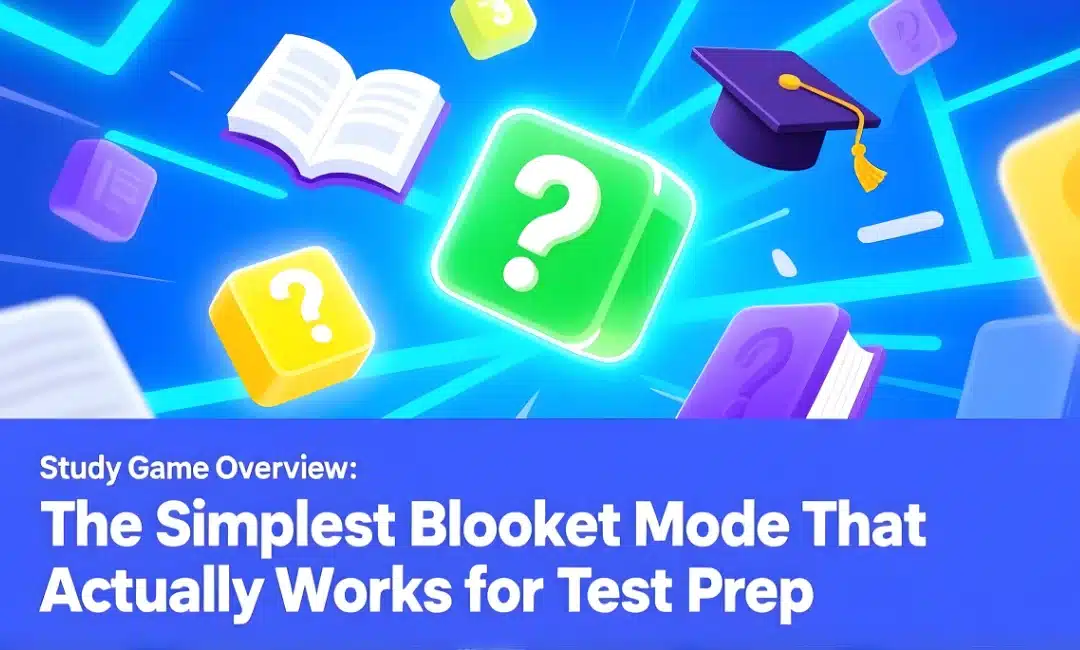
I used to think flashcards were boring. Then I saw Study mode help a failing student ace her vocabulary test.
Here’s why this basic Blooket study tool is secretly the most underrated mode.
What Study Mode Actually Is
No competition. No power-ups. No chaos.
Just you, the questions, and your answers.
It’s digital flashcards on steroids.
Answer correctly, move forward. Answer wrong, the question comes back later.
Pure practice. Zero distractions.
Why Simple Beats Complicated for Certain Goals
Every other Blooket mode adds layers. Competition. Timers. Mechanics.
Study mode strips all that away.
Sometimes students don’t need gamification. They need repetition.
They don’t need motivation. They need mastery.
Study mode gives them exactly that. Nothing more, nothing less.
The Spaced Repetition Nobody Talks About
Here’s the genius part most teachers miss:
Wrong answers don’t disappear. They cycle back.
The game won’t let you move forward until you get it right.
That’s not punishment. That’s science-backed learning.
I had a student miss “photosynthesis” three times. The fourth time? She got it.
Two weeks later on the test? She still had it.
When Study Mode Destroys Other Options
Use it when:
- Students need independent test prep
- Competition creates anxiety
- You’re teaching brand new vocabulary
- Students need self-paced practice
- Mastery matters more than speed
Skip it when:
- You need group energy
- Students require external motivation
- The goal is engagement over mastery
- Content is already memorized
I tried using this during a Friday afternoon. Total flop.
Students needed energy, not flashcards. Wrong tool, wrong time.
My Exact Setup for Maximum Retention
Here’s how I use Study Blooket mode:
- Keep question sets to 15-20 items (more gets overwhelming)
- Use it for homework or stations (not whole-class instruction)
- Mix question types (multiple choice, true/false, fill-in)
- Check progress through analytics (see who’s actually practicing)
That last point is critical. Study mode tracks everything.
You can see exactly which students practiced and which ones didn’t.
The Self-Paced Learning That Changes Everything
In whole-class games, fast students wait. Slow students panic.
Study mode eliminates both problems.
Fast learners move quickly. Struggling learners take their time.
Nobody’s left behind. Nobody’s held back.
One student with processing speed issues told me: “This is the first review that doesn’t make me feel stupid.”
That’s inclusion without announcing it.
What Students Actually Say About It
“It’s boring but it works.”
That’s the most common feedback. And I love it.
They’re not playing for fun. They’re playing to learn.
Another student said: “I kept getting ‘mitosis’ wrong so I made myself remember it.”
That’s ownership. That’s metacognition.
The game didn’t teach her. She taught herself. The game just provided structure.
The Analytics Feature Teachers Ignore
Study mode gives you data other modes don’t:
- Which questions students miss most
- How many attempts each question took
- Total time spent per student
- Individual progress tracking
This isn’t just a game. It’s a formative assessment.
I found out 18 students couldn’t spell “necessary” after reviewing the data.
Adjusted my instruction. Retaught it. Problem solved.
Common Teacher Mistakes with Study Mode
Mistake #1: Using it for whole-class instruction.
This is individual practice. Use it for homework or stations.
Mistake #2: Making question sets too long.
20 items max. More than that kills motivation.
Mistake #3: Never check the analytics.
You’re sitting on gold mine data. Use it.
Mistake #4: Comparing it to competitive modes.
It’s not supposed to be exciting. It’s supposed to work.
Quick FAQ: Study Game Mode
Is there a time limit?
No. Students work at their own pace completely.
Do wrong answers count against them?
No penalties. Just repeated practice until mastery.
Can I use this for grades?
You can, but I use it for practice only. Low-stakes learning.
What’s the ideal question set size?
15-20 questions. Sweet spot for practice without burnout.
Real Results from Real Students
I assigned Study mode homework before every vocabulary test for one semester.
Students who used it averaged 89%. Students who didn’t averaged 72%.
Same teaching. Same content. Different practice methods.
The ones who put in 15 minutes with Study mode outperformed everyone else.
Not because it’s magical. Because it forces repetition until mastery.
Why This Works for Struggling Learners
Students who fall behind often have gaps in basic knowledge.
Competitive games expose those gaps publicly. Humiliating.
Study mode lets them fill gaps privately.
No audience. No comparison. No shame.
Just them and the content until they get it right.
I’ve had students go from failing to passing by using this 10 minutes per night.
The Homework Assignment That Actually Gets Done
Most homework gets ignored. Study mode has 80%+ completion in my classes.
Why? It’s clear, it’s limited, and it tracks completion.
Students know exactly what to do. Finish the set. That’s it.
Parents can see progress. Students can see improvement.
Transparency creates accountability without nagging.
The Truth About “Boring” Learning Tools
Not everything needs to be exciting. Some learning requires grinding.
Study mode is the grind. And grinding builds mastery.
Athletes drill fundamentals. Musicians practice scales.
Students need repetition too. This mode provides it.
Is it fun? No. Does it work? Absolutely.
When to Pull Out Study Mode
Before tests. Before quizzes. Before presentations.
Anytime mastery is non-negotiable.
I tell students: “Play the fun modes in class. Use Study mode at home.”
Separates entertainment from essential practice.
Both have their place. This is the place for serious preparation.
The Confidence Builder Nobody Expected
Here’s something unexpected: Students love seeing their progress.
They miss “democracy” five times. Then they get it.
That moment of finally getting it right? That builds confidence.
Not participation trophy confidence. Earned competency confidence.
One student told me: “I didn’t think I could learn this. But I did.”
That’s what Study mode creates. Proof that effort leads to mastery.
Why Simple Tools Win Long-Term
Flashy games hook attention. Simple tools build skills.
Study mode isn’t competing for engagement. It’s delivering results.
Will students choose it over Zorblitz? Never.
Will it prepare them better for assessments? Every single time.
Use Study game overview when test prep matters more than entertainment. Your students’ scores will prove it worked.