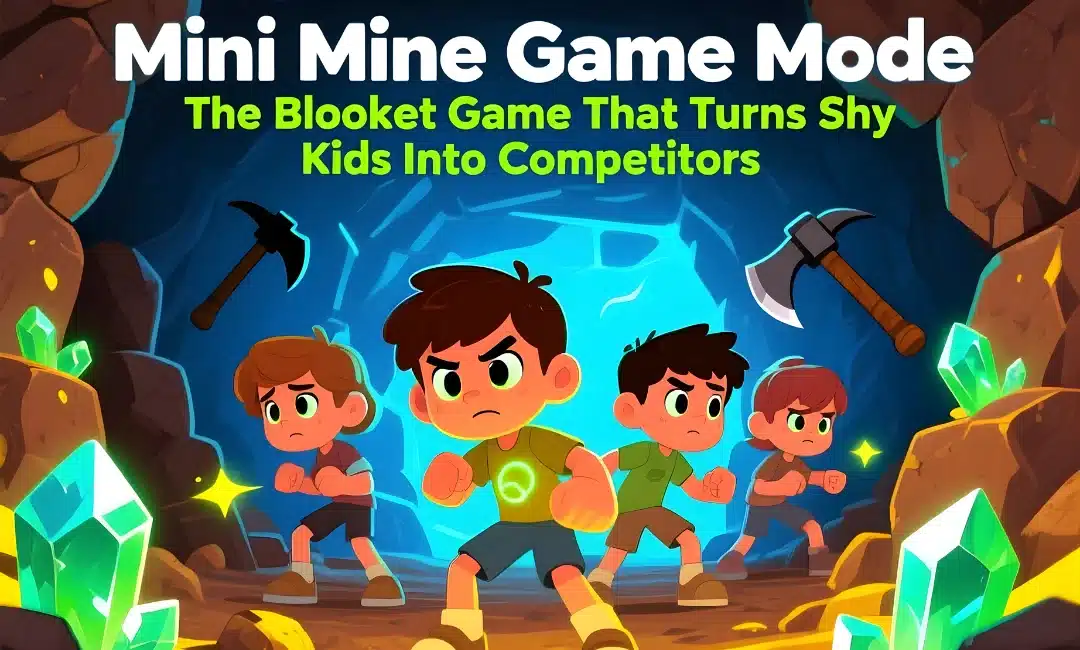
I had a student who never participated in anything competitive. Then I ran Mini Mine and she ended up screaming at her screen in excitement.
Here’s why this Blooket mining game is different from every other mode.
What Mini Mine Actually Does
You’re a miner. You dig for gems. You answer questions to mine deeper.
But here’s the twist: You’re not just racing other students.
You’re racing the cave itself. Every correct answer digs deeper. Wrong answers waste time.
The competition feels indirect. That’s the magic.
Why Indirect Competition Changes Everything
Most games put you head-to-head with other students.
That’s intimidating. Some kids shut down immediately.
Mini Mine gameplay is different:
- You see your own progress clearly
- Other players’ scores don’t feel threatening
- It’s you vs. the challenge, not you vs. Tyler who answers in 2 seconds
I’ve watched anxious students relax and actually try because they’re not constantly comparing themselves.
That’s powerful. That’s an inclusive design.
The Mining Mechanics That Keep Students Hooked
Here’s what happens during gameplay:
Layer 1-3: Easy digging, common gems, builds confidence
Layer 4-6: Questions get harder, gems get valuable, tension rises
Layer 7+: Rare gems appear, everyone’s hunting for the big score
The progressive difficulty means early success hooks them. Later challenge keeps them engaged.
I ran this with struggling readers once. They made it to layer 5 before I even realized they were reading above their comfort level.
When Mini Mine Beats Every Other Game Mode
Use it when:
- You have students with mixed confidence levels
- Competition usually creates anxiety in your class
- You’re reviewing content with varying difficulty
- Students need individual pacing
- You want engagement without chaos
Skip it when:
- You specifically need team collaboration
- Time pressure is part of your learning goal
- Students thrive on direct competition
I tried it during a high-energy Friday afternoon. Perfect choice.
Kept everyone calm but focused. No arguments about who won or lost.
My Step-by-Step Launch Strategy
Here’s my exact Mini Mine setup:
- Load 20-30 questions (more than other games—pacing is slower)
- Set timer to 15-20 minutes (don’t rush this one)
- Include some easy wins early (first 5 questions should be confidence builders)
- Add 3-4 really hard questions (for the deep layers)
The difficulty curve matters more here than in any other mode.
Start too hard? Students give up. Keep it too easy? They get bored.
What Makes the Gem System Brilliant
Not all correct answers are equal in Mini Mine.
Common gems = 10 points. Rare gems = 50+ points.
Students learn to push deeper even when questions get hard.
It’s like real mining. The deeper you go, the better the reward.
One kid told me: “I got a question wrong but I’m still winning because I found a diamond.”
That’s the kind of resilience we want to build.
The Feedback Loop Nobody Talks About
Every dig shows immediate visual progress.
You see the pickaxe hit. You see the gems appear. You see your depth increase.
Instant feedback = instant motivation.
Compare that to worksheets where feedback comes tomorrow or never.
The brain craves immediate rewards. Mini Mine delivers them constantly.
Teacher Mistakes I See All the Time
Mistake #1: Using it for fast recall practice.
This game is about persistence, not speed. Wrong content fit.
Mistake #2: Not explaining the layer system upfront.
Students don’t realize deeper = better unless you tell them.
Mistake #3: Making all questions the same difficulty.
The whole point is progressive challenge. Mix it up.
Quick FAQ: Mini Mine Mode
How long does a typical game last?
15-20 minutes with 25-30 questions. Shorter than most modes.
Can students see each other’s progress?
They see the leaderboard but focus stays on their own mine.
What happens if they answer wrong?
They don’t lose points. They just don’t dig deeper. No penalty.
Is this good for test prep?
Excellent. Low pressure but high engagement. Perfect review tool.
Real Results From My Classroom
I used Mini Mine for state capitals review.
Usually, 40% of students check out during geography.
With Mini Mine Blooket, 87% stayed engaged the entire time.
Same content. Different delivery. Completely different outcome.
The quietest kid in class ended up in second place and asked if we could play again tomorrow.
The Truth About This Game Mode
Most teachers overlook Mini Mine because it’s not flashy.
No explosions. No racing. No team battles.
But it works for the students other games leave behind.
The competitive kids still compete. The anxious kids finally participate.
That’s rare. That’s worth using.
Try Mini Mine next time you need full-class engagement without full-class chaos. You’ll see what I mean.